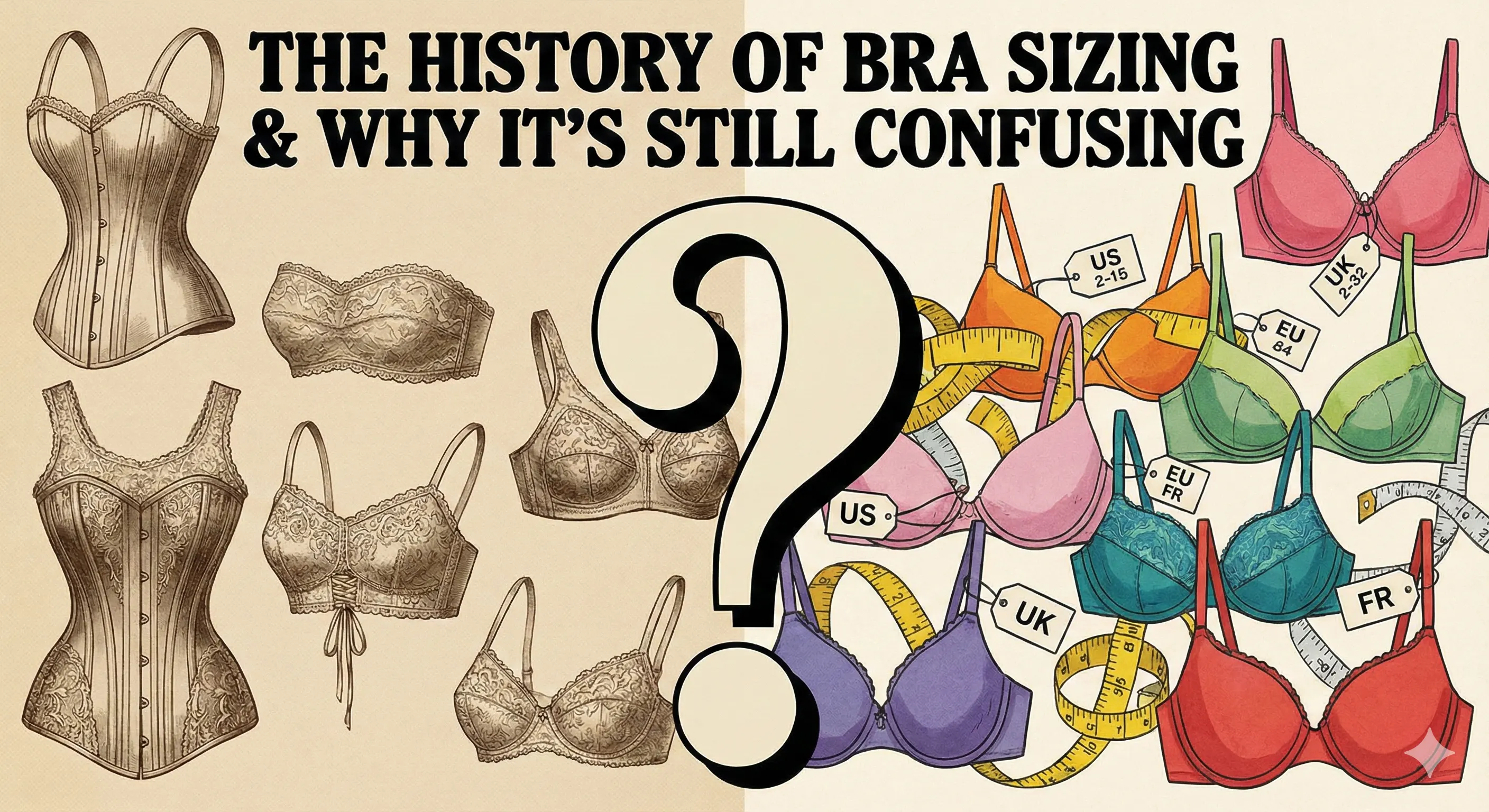
Finding a bra that fits shouldn't feel like solving a complex math puzzle—but for millions of women, The History of Bra Sizing & Why It’s Still Confusing explains exactly why the struggle remains real. From outdated measurements to inconsistent brand systems, bra sizing has a surprisingly tangled past that continues to affect shoppers today.
Let’s break it down in a clear, engaging way.
Early Origins of Breast Support
Long before modern sizing existed, women across ancient civilizations created garments that offered structure and modesty. Ancient Greek women wrapped fabric bands around their chests, while Roman women used the strophium, a supportive linen strip. Fast-forward to the Middle Ages, and corsets became the dominant support garment.
The Corset Era
Corsets were never designed around natural anatomy. Instead, they shaped the torso to match the fashion of the era—whether cone-shaped, hourglass, or exaggeratedly narrow. Because corsets supported the bust from below, bra sizing simply didn’t exist.
Birth of the Modern Bra (1910–1920)
Everything changed when Mary Phelps Jacob (also known as Caresse Crosby) patented the first modern bra in 1914. Using two handkerchiefs and ribbon, she created a lightweight garment that freed women from rigid corsets.
With more women entering the workforce during WWI, bras became a necessity—not a luxury.
The First Sizing System Emerges
By the 1920s, manufacturers realized they needed a way to categorize sizes. Early bras came in small, medium, and large, but this didn’t account for breast shape or volume.
The real breakthrough came in the 1930s when cup sizing was invented.
Warner’s Standardization of Cup Sizes (1930s)
Warner’s introduced the A, B, C, D cup system, claiming each letter represented a different volume of breast tissue. While this became the global standard, its logic was flawed from the start:
- Cup size doesn’t represent volume alone
- Volume changes relative to band size
- Letter systems varied across brands
This created a confusing foundation that still affects sizing today.
Post-War Fashion & Changing Silhouettes
The 1940s and 1950s introduced the iconic bullet bra, which shaped the bust into a pointed silhouette. Cup design began focusing on projection and lift, but sizing remained inconsistent.
Why the System Broke: Manufacturing Limitations
Imagine trying to fit millions of bodies into a few predetermined size combinations. That’s what manufacturers attempted. To simplify production:
- Band sizes were standardized
- Cup sizes were limited
- Body diversity was ignored
The result? Most women fell between sizes rather than in them.
The Rise of Vanity Sizing
In the 1970s and 1980s, brands began using vanity sizing—assigning more “desirable” numbers or letters to boost customer confidence. This made sizing even more inconsistent across stores.
Why It’s Still Confusing Today
Today’s confusion stems from several factors:
- International sizing differences (UK vs. EU vs. US)
- Brand-by-brand variation
- Inconsistent grading systems
- Misunderstanding sister sizes
For example, a 34D in one brand may fit like a 32DD in another.
The Problem With Band + Cup Math
Cup size is meaningless without the band. A D cup on a 30 band is significantly smaller than a D cup on a 38 band. Most shoppers don’t know this—and many stores don’t explain it.
Modern Fitting Science
Biomechanics research now reveals how breast movement works during activity. This has led to better sports bra engineering, padded support zones, and breathable materials.
3D scanners can measure the breast shape, root width, and position more accurately than tape measurements alone.
The Role of Cultural Expectations
Throughout history, desired silhouettes shifted—from the pointed bust of the ’50s to the natural shape of the ’70s to the push-up craze of the ’90s. These ideals influenced how bras were designed and marketed.
Inclusive Sizing Movements
Brands specializing in small band/large cup and plus-size options emerged to fill gaps the traditional market ignored.
This gave rise to labels offering:
- 28 bands
- Cups up to K+
- Custom-fitting options
Digital Bra Fitting & AI Tools
Bra-fitting calculators and virtual try-on tools attempt to reduce confusion. While helpful, most still rely on outdated measurement logic.
For further reading, you can explore research on sizing evolution here: https://www.sciencedirect.com/
The Future of Bra Sizing
Experts predict a shift toward:
- Shape-based systems
- Volume-based systems
- Universal size language
- Greater size inclusivity
Some brands already use 3D scanning to create shape profiles rather than lettered cup sizes.
How to Find Your Best Fit Today
Here’s what helps most:
- Measure both snug and loose underbust
- Consider tissue distribution and breast shape
- Know your sister sizes
- Try multiple brands—their sizing differs!
- Use modern fit calculators as a starting point, not a rule
FAQs About Bra Sizing
1. Why do bra sizes vary so much between brands?
Every brand uses different grading rules, materials, and fit models.
2. What is a sister size?
A size that changes the band and cup to maintain similar volume (e.g., 34D = 32DD).
3. Why don't stores carry more cup sizes?
Inventory costs are high, and many stores stick to limited ranges.
4. What’s the most accurate way to measure your bra size?
Use multiple measurements and consider shape, not just numbers.
5. Is the tape-measure method outdated?
Partially—modern breast anatomy research suggests volume and shape matter more.
6. Will bra sizing ever be standardized?
Possibly, but industry-wide change is slow and costly.
Conclusion
The History of Bra Sizing & Why It’s Still Confusing shows that today’s sizing problems didn’t appear overnight—they were built over a century of inconsistent systems, shifting fashion trends, and mass manufacturing challenges. While tools and technology continue to improve, the most reliable method remains understanding your body, experimenting with sizes, and choosing brands that prioritize fit.